Veganism
Introduction
Veganism was never meant to be a diet, a passing choice for the health-conscious or the fashionable. It was born of anguish, of the refusal to remain complicit in cruelty. Donald Watson and his companions looked at the slaughterhouses of their time and heard not only the cries of animals but the echo of their own humanity in those cries. They knew that to consume flesh, milk, eggs, honey, was to say: your life is worth less than my appetite. And so they said no. They called it veganism, and it was an act of rebellion, a claim that justice could not be divided between human and non-human, between convenient and inconvenient.
But rebellion in America rarely survives the marketplace. What begins as a cry for dignity is repackaged, stripped of its moral fire, and sold back to us with a logo. So it is with veganism, which once meant compassion and defiance, and now too often means only “Certified Vegan.” A label. A diet. A way of avoiding guilt without confronting truth.
The Roots of Veganism
When Watson coined the term vegan in 1944, he was not inventing a fad. He was answering a question as old as conscience itself: How much suffering are you willing to ignore to sustain your comfort? He rejected not only meat but milk, eggs, honey—all the byproducts of bodies pressed into service. His reasoning was simple, and therefore radical: if cruelty is wrong, then all cruelty is wrong.
The Vegan Society codified this principle: eliminate “as far as possible and practicable, all forms of exploitation of, and cruelty to, animals.” The word all mattered. It meant veganism was not merely about food. It was a philosophy, a demand to reckon with the lives we use, the lives we discard.
The Rise of Vegan Certification
Decades later, in America, veganism was given a logo. Vegan Action, with its Certified Vegan mark, promised clarity for the consumer. For a fee, companies could purchase permission to claim their products as cruelty-free. And with that logo came visibility, funding, the expansion of advocacy groups.
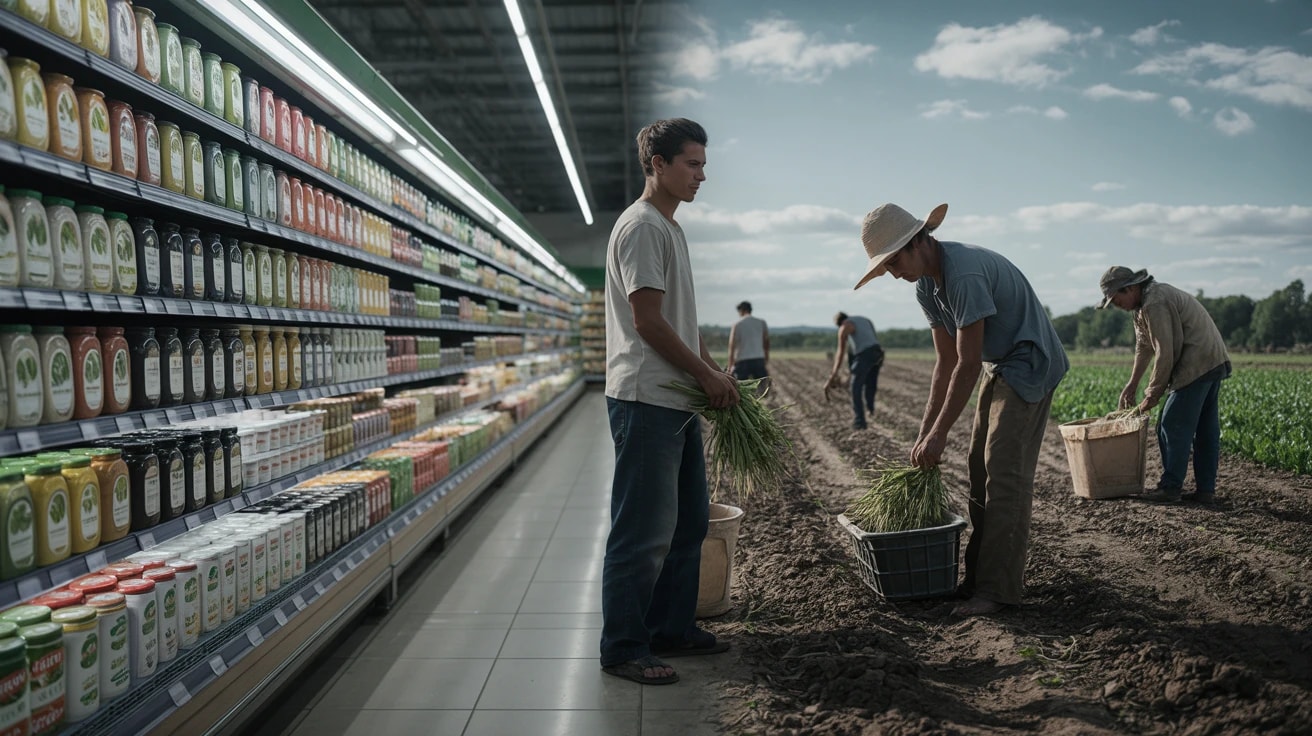
But every bargain has a cost. In reducing veganism to what could be audited, the movement narrowed its own scope. Cruelty became something you could measure by ingredients. No milk, no eggs, no flesh: therefore, no guilt. But the fields where children harvest cocoa, the plantations where men and women toil for pennies, the migrant workers breathing pesticides as they stoop over lettuce—none of this counted. Because the cruelty was human.
And in that omission lies the betrayal.
Ethical Misalignment
It is a strange and terrible irony that a philosophy born to end exploitation now tolerates it, provided the victims are human. A chocolate bar produced by children in chains may still bear the Certified Vegan logo, because the cruelty was visited not upon cows, but upon boys and girls. Coffee harvested through trafficking and forced labor may sit in the same aisle as “cruelty-free” alternatives, though the cruelty is written in the calluses and lungs of the workers.
We call these foods vegan. But what do we mean by the word animal? Do we imagine we are not animals? That our suffering does not count?
Humans are animals. Sentient beings. To claim a product is free of cruelty because it contains no animal flesh, while it contains the sweat, the blood, the stolen childhoods of human beings, is to declare that some animals do not matter. And that declaration is precisely what veganism was meant to resist.
Veganism or Marketed Vegetarianism?
What passes for veganism in the marketplace is not rebellion. It is not philosophy. It is, in truth, a stricter vegetarianism with better branding. It excludes meat and dairy, yes, but it does not exclude the exploitation on which entire industries rest.
This is not to deny progress. Plant-based alternatives have expanded. Awareness has grown. But let us be honest: the consumer label called “vegan” today is a shadow of Watson’s vision. It comforts without confronting. It sells without saving.
Key Observations
- Narrowed Scope: Certification pretends cruelty applies only to non-human animals. Human exploitation is invisible.
- Revenue Model: The logo sustains organizations financially, but incentivizes simplicity over moral truth.
- Philosophical Inconsistency: To say humans are animals, yet exclude them from protection, is to betray the very foundation of veganism.
- Consumer Illusion: Shoppers equate “vegan” with “cruelty-free.” But cruelty, vast and unrelenting, hides in the fields and the factories.
Conclusion: Toward a Truer Veganism
The question is not simply what we eat. The question is who we become when we blind ourselves to suffering. Veganism, in its truest form, is not a consumer choice but a moral reckoning. It demands that we see the child in the cocoa fields, the migrant in the lettuce rows, the cow in the slaughterhouse, and confess that their lives are bound to ours.
To settle for a logo, for a sanitized label, is to choose innocence at the price of truth. But innocence cannot be purchased. Innocence is a lie.
The challenge is here, and it will not wait: will veganism remain a diet, a brand, a comfortable fiction? Or will it reclaim its roots as a philosophy of justice, insisting that no sentient being—human or otherwise—may be used, commodified, or cast aside for profit?
The answer belongs to us. It belongs to every hand that buys, every mouth that eats, every conscience that dares to look into the mirror and not turn away.