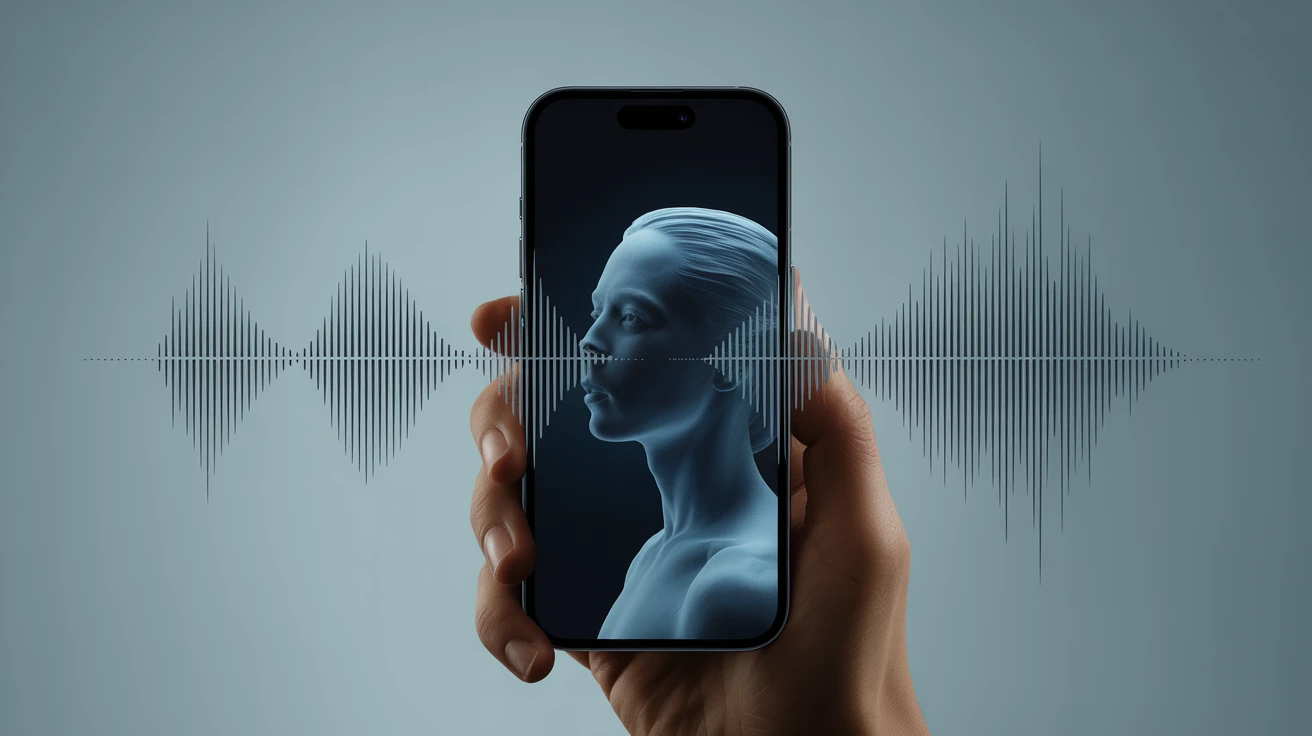
The Voice Is the Person
A voice once meant presence. It was proof that someone was there, breathing, speaking, reaching toward you across the space between. To hear another was to confirm their being. Now we are confronted with voices that arrive without bodies, conjured from fragments of recorded sound. A call in the night can bear the cry of a daughter, though she sleeps safely in another room. The voice convinces even when the story does not.
Voices carry histories. They are shaped by accent, by time, by health, by the fatigue of a late evening or the energy of a morning. A voice is not simply information—it is a way of being seen through sound. To recognize someone by their voice is to locate them within memory, within intimacy. What happens when the technology of simulation learns to reproduce this recognition with such precision that it no longer requires the person at all?
How Machines Learn to Speak in Our Place
From the listener’s side, the process feels uncanny. You hear words spoken in a familiar tone, but behind it is no body, no breath. Technically, the machine works by listening once and then remembering forever. A fragment of speech is reduced to a set of measures: pitch, rhythm, resonance. From this profile, any sentence can be generated.
“The forgery unsettles not just the ear but our trust in what hearing once meant.”
The older methods built speech sound by sound, mechanical in rhythm, like someone tracing letters slowly on a page. The newer ones—diffusion models, transformer systems—breathe whole sentences at once, smoothing intonation, filling pauses, creating the illusion of spontaneity. These systems no longer only match the sound of a voice but also its moods: a laugh, a whisper, a rising tension.
Imagine a forger who, after studying one signature, can sign an entire library of documents. That is what voice cloning achieves. The imitation unsettles not just our ear but our trust in what hearing once meant.
Voices That Return Without the Speaker
On Screen and Stage
We have already heard voices pulled out of time. A young Luke Skywalker speaks again on screen; Darth Vader growls with menace long after the actor who defined him has withdrawn from performance. Val Kilmer, robbed of speech by illness, is briefly returned his own voice through the careful stitching of archived sound.
These acts are treated with reverence, sometimes with unease. They remind us that the voice can be prolonged beyond the body, suspended between past and present. They also remind us that what we hear may no longer be tethered to the moment of speaking.
In Books and Newsrooms
Books are now read aloud by narrators who never sat in a studio, their voices multiplied and extended by machine. A journalist’s familiar tone can tell a story in print and then repeat it in sound without the journalist ever opening their mouth. What once required hours of labor can now be summoned in seconds.
“We are accustomed to subtitles and dubbing—but when the voice itself crosses boundaries, what remains of authenticity?”
The experience for the listener is seamless. Yet the awareness lingers: if a voice can be replicated, what binds it to authorship? When does a story become someone else’s performance rather than one’s own?
Across Languages
More extraordinary still are the voices that cross languages. A podcast host speaks in English and is heard in Spanish, French, Mandarin—always with the same cadence, the same timbre. The words are translated but the voice persists. The illusion is persuasive: the same person, speaking fluently in tongues they do not know.
We are accustomed to subtitles, to dubbing, to the friction of translation. But when the voice itself crosses these boundaries, unchanged, what remains of the difference between native and foreign, between lived experience and simulation?
Unexpected Uses
Not all uses are industrial or spectacular. A patient records fragments of speech before losing the ability to talk; later, their synthetic voice restores a measure of dignity. Families keep the sound of a loved one alive after death. The machine’s capacity to give back what illness or time has taken away is not illusion but a gift.
“The same tools that terrorize can also console.”
Placed beside the stories of deception, these intimate restorations sharpen the contrast: the same tools that terrorize can also console.
The Fragile Boundary Between Trust and Imitation
Who Owns a Voice?
The law has begun to notice what the ear already suspects—that a voice can be stolen. Decades ago, courts ruled that to imitate a singer’s distinctive tone for an advertisement was to trespass on her identity. Today, unions insist that no studio may claim an actor’s voice without explicit consent, that contracts must protect what was once inalienable: the right to one’s own sound.
Some imagine new marketplaces, where a performer licenses a digital likeness of their voice, setting conditions and price. Here, the voice becomes property, tradable, rentable. What was once inseparable from the body is abstracted into an asset.
When Deception Speaks
But outside these contracts, voices are already being stolen. A parent receives a desperate call from a child in distress. A company director hears what seems to be his superior ordering a transfer of funds. A politician is recorded saying words she never uttered.
“Because we have trusted voices more than we trust images, these imitations cut deeper.”
Because we have trusted voices more than we trust images, these imitations cut deeper. They destabilize our assumption that hearing confirms truth. When everything can sound real, the category of the real itself is diminished.
Restoring and Extending Voices
Against this disquiet are undeniable gains. For the voiceless, the technology offers restoration. For creators, it offers reach across borders and languages. For families, it offers preservation, the chance to hear again what has been lost.
“The voice, multiplied, translated, extended, becomes a tool of connection as well as deception.”
The voice, multiplied, translated, extended, becomes a tool of connection as well as deception. It is at once generous and dangerous.
To listen has always been to trust: to the authority of a teacher, the intimacy of a lover, the reassurance of a parent. Voice was the presence behind the words. Now presence can be manufactured. The consequence is not only that we might be fooled, but that we might lose the certainty of recognition itself.
If every voice can be repeated without the speaker, how do we distinguish between gift and forgery? Perhaps the question is not whether we can detect the difference but what it does to us to live in a world where detection is always necessary.
“To listen has always been to trust. Now presence itself can be manufactured.”
The promise is that voices will cross borders, heal silence, preserve memory. The risk is that voices will be stripped of their guarantee of selfhood. Between these two, we must learn to listen differently—not only to the sound but to the context, to what is revealed and what is withheld.
And voices will not remain solitary. Soon they will be woven together with sight and gesture, folded into agents that speak, see, and act across every medium. When that happens, the question will no longer be just whose voice we hear, but whose presence we encounter.
A voice once meant presence. What will it mean next?
Next in the series: Everyone Talks, the Machine Listens
- Respeecher. “How Respeecher’s Voice Cloning Brought Young Luke Skywalker’s Voice to ‘The Mandalorian’.” Respeecher Case Study, 2023. https://www.respeecher.com/case-studies/respeecher-synthesized-younger-luke-skywalkers-voice-disneys-mandalorian.
- Shamsian, Jacob. “Val Kilmer’s Voice in ‘Top Gun: Maverick’ Was Recreated with AI.” Variety, 2022. https://variety.com/2022/film/news/val-kilmer-top-gun-maverick-voice-artificial-intelligence-1235281512/.
- Spotify Newsroom. “Spotify’s AI Voice Translation Pilot.” Spotify, 2023. https://newsroom.spotify.com/2023-09-25/ai-voice-translation-pilot-lex-fridman-dax-shepard-steven-bartlett/.
- Khalid, Amrita. “Spotify Is Going to Clone Podcasters’ Voices — and Translate Them.” The Verge, 2023. https://www.theverge.com/2023/9/25/23888009/spotify-podcast-translation-voice-replication-open-ai.
- Meta AI. “Introducing Voicebox: The First Generative AI Model for Speech to Generalize Across Tasks.” Meta AI Blog, 2023. https://ai.meta.com/blog/voicebox-generative-ai-model-speech/.
- Microsoft Research. “VALL-E: Neural Codec Language Models Are Zero-Shot Text-to-Speech Synthesizers.” Microsoft Research Project Page, 2023–2024. https://www.microsoft.com/en-us/research/project/vall-e-x/.
- U.S. Court of Appeals for the Ninth Circuit. Midler v. Ford Motor Co., 849 F.2d 460 (9th Cir. 1988). 1988. https://cyber.harvard.edu/people/tfisher/1988%20Midler.pdf.
- SAG-AFTRA. “Digital Replicas: Protections for Performers in the 2023 TV/Theatrical Contracts.” SAG-AFTRA, 2023. https://www.sagaftra.org/sites/default/files/sa_documents/DigitalReplicas.pdf.
- The Verge Staff. “Apple Books Quietly Launches AI-Narrated Audiobooks.” The Verge, 2023. https://www.theverge.com/2023/1/5/23540261/apple-text-to-speech-audiobooks-ebooks-artificial-intelligence-narrator-madison-jackson.
- The Washington Post (PR). “The Washington Post Expands Accessibility with AI-Read Newsletters.” Washington Post PR, 2024. https://www.washingtonpost.com/pr/2024/05/20/washington-post-expands-accessibility-ai-read-newsletters-enhancing-user-experience-through-audio/.
- GMA / ABC News. “Mom Warns of Hoax Using AI to Clone Daughter’s Voice.” ABC News, 2023. https://abcnews.go.com/GMA/Family/mom-warns-hoax-ai-clone-daughters-voice/story?id=98551351.
- Roman, R.S., Fez, P., et al. “Proactive Detection of Voice Cloning with Localized Watermarking (AudioSeal).” arXiv, 2024. https://arxiv.org/abs/2401.17264.
- Resemble AI. “Protect Your IP with Neural Audio Watermarker (PerTh).” Resemble AI, 2023. https://www.resemble.ai/watermarker/.
- Verma, Pranshu and Will Oremus. “AI Voice Clones Mimic Politicians and Celebrities, Reshaping Reality.” The Washington Post, 2023. https://www.washingtonpost.com/technology/2023/10/13/ai-voice-cloning-deepfakes/.
- Microsoft Research / Synced. “Microsoft’s VALL-E 2 Achieves Human Parity in Zero-Shot TTS.” Synced Review, 2024. https://syncedreview.com/2024/06/11/microsofts-vall-e-2-first-time-human-parity-in-zero-shot-text-to-speech-achieved/.
- ElevenLabs. “The Most Expressive Text-to-Speech Model (Platform Overview).” ElevenLabs, 2024–2025. https://elevenlabs.io/text-to-speech.