The Vanishing Apprenticeship
A film set is never silent. It hums with the low chorus of people at work: the shuffle of extras waiting in line, the grip shifting a light, the production assistant slipping a note to a harried director. Even in the pauses, there is presence—each task a rung on the ladder of a profession built from learning by watching, by doing, by proximity.
Now picture the same set, stripped of its noise. The extras dissolve into digital replicas. The storyboard arrives not from a junior artist’s pencil but from an algorithm’s prompt. Dialogue is cleaned, not by an assistant leaning over a console, but by software tidying phonemes. The air remains still, the camera still rolls. Yet the people who once crowded the margins of the frame have gone missing.
What is at stake is not the spectacle of film itself—it will endure—but the pathways that once led people into it. The apprenticeship, invisible but essential, is vanishing.
When the First Steps Disappear
For as long as cinema has existed, the journey to mastery has begun in the margins. The assistant editor cutting tape. The production assistant fetching coffee, listening in on whispered instructions. The extra blending into a crowd scene, waiting to be called again tomorrow. These roles were not glamorous, but they were the first steps up the ladder.
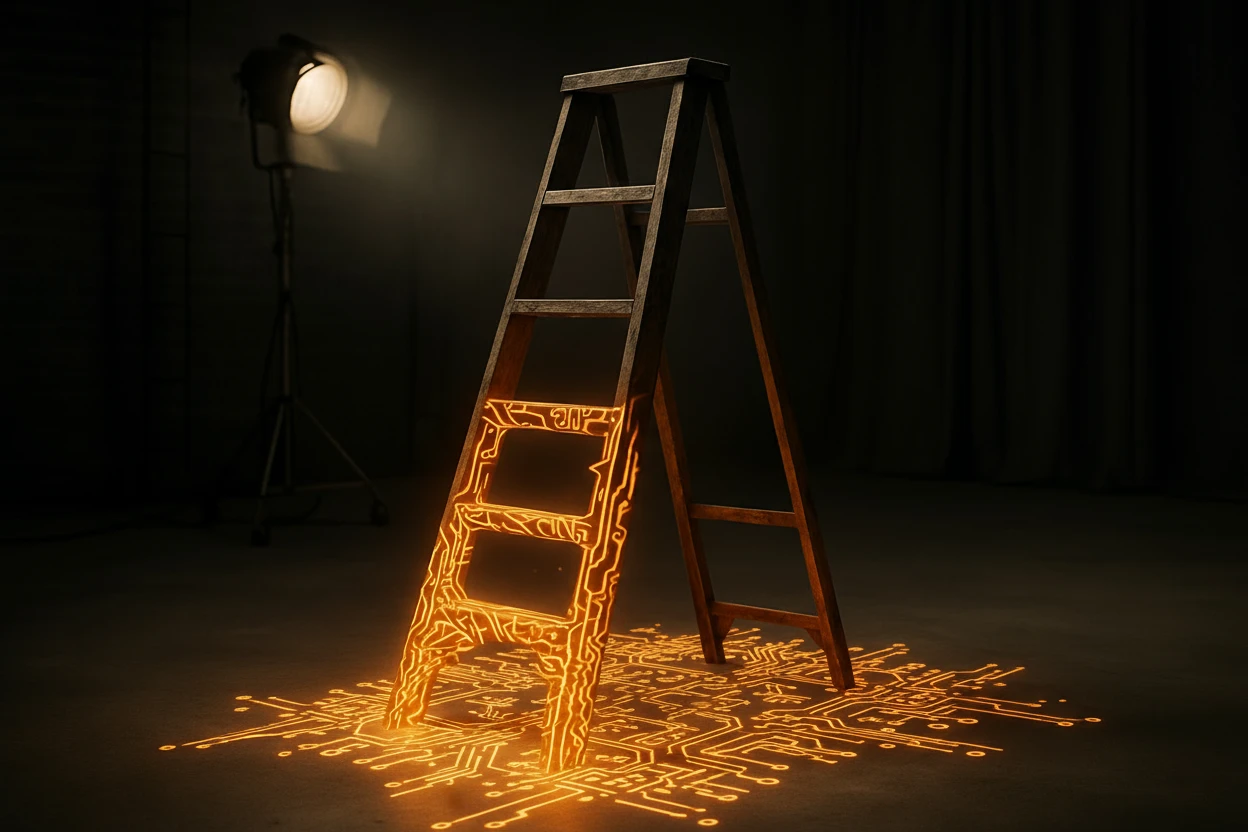
Artificial intelligence reshapes that ladder by taking away its lower rungs.
- Generative video and sound: Tools such as Sora or Veo merge image and audio in a single pass, replacing the piecemeal work of camera crews, foley artists, and editors.
- Previsualization as parameter: Runway’s camera path tools simulate the movements of a cinematographer, flattening a lesson once learned by trial, error, and mentorship.
- Replicated crowds: Extras can be scanned and redeployed infinitely, reducing a day’s human labor to a dataset echo.
- Automated postproduction: Rotoscoping, color assists, and dialogue cleanup—all once training grounds—are compressed into a menu of filters.
Imagine looking at a ladder whose bottom rungs have been sawn off. It is still there, but only those already standing close to the top can reach it.
Flashpoints and Fractures on Set
A Horror Film and a Flashpoint
In 2024, the indie horror film Late Night With the Devil slipped a few AI-generated stills into its narrative—interstitial images meant to mimic period television. The uproar was louder than the images were significant. Audiences sensed not a gimmick, but an omen. If even the smallest insert could be offloaded to a machine, what else might follow? The outrage was less about the picture itself and more about the unseen workers it displaced.
The Battle for Backgrounds
SAG-AFTRA’s fiercest struggle was not about lead actors but about background players. Extras, whose faces we barely register in the crowd, became bargaining symbols. Studios sought to scan them once and reuse them endlessly. Contracts now insist on consent and compensation, but the anxiety lingers: a life of piecemeal work can be digitized into a perpetual shadow.
Apprentices in the Editing Room
Assistants once learned rhythm by cleaning dialogue, syncing reels, trimming excess frames. Today, transcription is handled by software; color correction is guided by algorithms. Those silent hours of practice, where craft was absorbed through repetition, are evaporating.
A Counterpoint in Precision
Not all uses erase. In The Brutalist, AI was deployed with surgical modesty—to smooth Hungarian phonetics in dialogue. No jobs disappeared; the technology extended a director’s intent. It is proof that the same tools can sharpen or sever, depending on how they are wielded.
What Vanishes Alongside the Work
Social Consequences
Apprenticeships have always been the gateway for the unconnected. They were the cracks through which new voices could enter. As these entry points close, opportunity contracts. The industry risks becoming the province only of those who already belong.
Cultural Consequences
Film language evolves through transmission. Young assistants absorb their mentors’ instincts, later bending or breaking them to find their own voice. Remove the spaces where this learning happens, and the diversity of vision narrows. Cinema becomes less a conversation across generations than a simulation of one.
Seeing Value Differently
From one angle, studios see efficiency: fewer extras, fewer assistants, fewer paid days. From another, we see loss: the depletion of human presence, the vanishing of opportunity. Value here is not only economic—it is visual, cultural, and social. What we fail to notice in the frame today may define who appears in the frame tomorrow.
Ethical Stakes
The fight is increasingly about ownership—of likeness, of voice, of consent. A scanned extra becomes a commodity. A digitized performance persists without its performer. What was once labor becomes property, severed from the body that made it.
Echoes in Other Professions
Look beyond the film set and the same pattern emerges.
- In law, paralegals once combed through boxes of documents; now software does.
- In journalism, interns once transcribed interviews, catching every hesitation; now transcription software erases that initiation.
- In design, juniors once proofed layouts, adjusting margins and kerning by hand; now templates smooth over those tasks.
In each case, the work is still done, but the people who once learned from it are absent. The disappearance begins at the bottom.
Credits Yet to Be Written
The credits of tomorrow’s films may list fewer names, or stranger ones: “Prompt Cinematographer,” “AI Compliance Officer.” New rungs may appear, but they will teach different skills—managing datasets instead of holding a boom, curating rights instead of framing a shot.
Unions are drawing lines, embedding AI clauses in contracts. Legislators experiment with disclosure and watermarking laws. Studios weigh short-term savings against long-term backlash. Audiences begin to demand transparency: notes on how AI was used, much as we expect environmental labels on food. The negotiation is not whether AI belongs, but under what terms.
Closing Reflection
Look at the film set in your mind’s eye. Do you see the assistants, the extras, the quiet work at the edge of the frame? Or do you see a stage increasingly filled with invisible processes, their labor hidden in code?
The real danger is not that machines will one day direct. It is that they will erase the places where humans once learned to. Without apprenticeships, the next generation of filmmakers may never stand behind the camera long enough to find a voice of their own.
Still, possibility lingers. If guided by consent, protection, and care, AI could relieve apprentices of drudgery rather than remove them altogether. It could make space for learning, not eliminate it. But that requires intention.
The flood of AI-generated images was only rehearsal. Now the stage is shifting. The question is not whether stories will be told. It is who will be left to tell them.
And if the apprenticeship vanishes from the set, what of the studio? The next arena where machines press against the edges of human learning is sound itself—the voices that once taught us how to feel and to belong.
Next in the series: Machines That Sing — Music in the Age of AI
- OpenAI, “Sora 2 is here,” OpenAI (2025). https://openai.com/index/sora-2/
- Carl Franzen, “OpenAI debuts Sora 2 AI video generator app with sound and self-insertion,” VentureBeat (2025). https://venturebeat.com/ai/openai-debuts-sora-2-ai-video-generator-app-with-sound-and-self-insertion
- “OpenAI’s new Sora video generator to require copyright holders to opt out,” Reuters (2025). https://www.reuters.com/technology/openais-new-sora-video-generator-require-copyright-holders-opt-out-wsj-reports-2025-09-29/
- “‘Late Night With the Devil’ Directors Clarify AI Image Use,” Variety (2024). https://variety.com/2024/film/news/late-night-with-the-devil-ai-images-clarification-1235947599/
- “’Late Night With the Devil’ AI Usage Sparks Debate,” IndieWire (2024). https://www.indiewire.com/news/general-news/late-night-with-the-devil-ai-backlash-explained-1234966938/
- “Film Commentary: AI – Is Hollywood in its Virtual Sights?” ArtsFuse (2025). https://artsfuse.org/309993/film-commentary-ai-is-hollywood-in-its-virtual-sights/
- “Sora, OpenAI’s video generator, has hit the UK,” The Guardian (2025). https://www.theguardian.com/technology/2025/feb/28/sora-openai-video-generation-tool-has-hit-the-uk-its-obvious-why-creatives-are-worried
- “Microsoft Bing gets a free Sora-powered AI video generator,” TechCrunch (2025). https://techcrunch.com/2025/06/02/microsoft-bing-gets-a-free-sora-powered-ai-video-generator/
- “OpenAI releases AI video generator Sora but limits how it depicts people,” Associated Press (2024). https://apnews.com/article/openai-sora-generative-ai-texttovideo-214d578d048f39c9c7b327f870dc6df8
- Bosung Kim, Kyuhwan Lee, Isu Jeong et al., “On-device Sora: Enabling Diffusion-Based Text-to-Video Generation for Mobile Devices,” arXiv (2025). https://arxiv.org/abs/2502.04363