The Truth About MSG
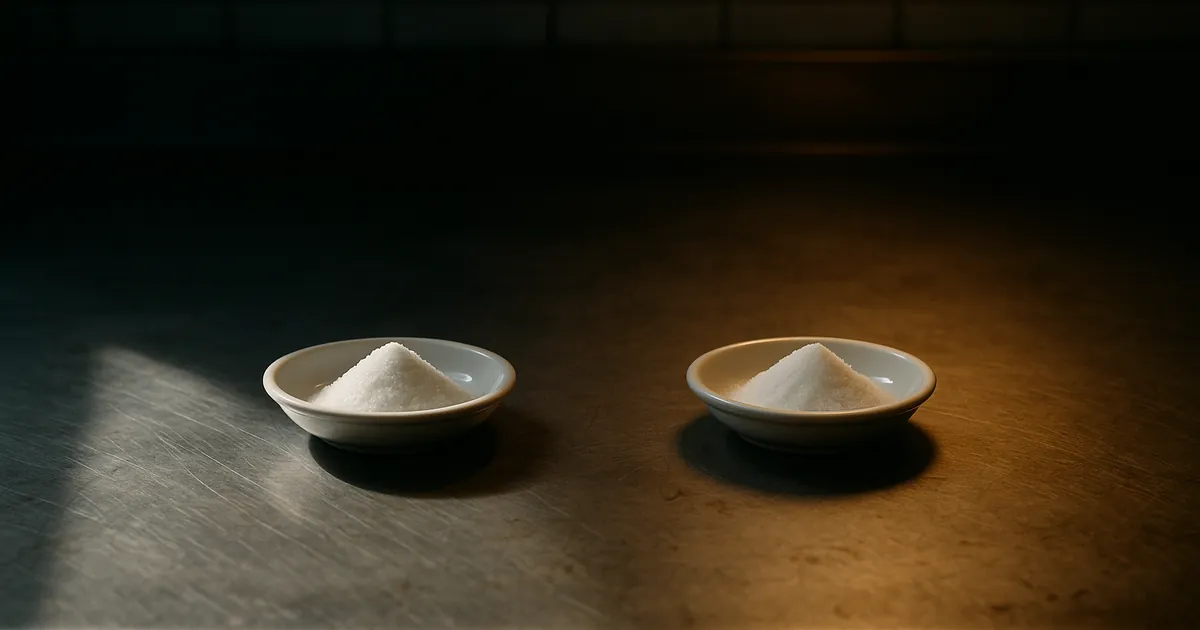
The same molecule sits in Parmesan and in Doritos — but only one address ever had to answer for it. How a 1968 letter became a syndrome named after a cuisine.
Somewhere near you, a restaurant is paying rent on a sign that says NO MSG.
Not a menu item. Not a special. A defense.
Nobody makes a sign like that because they are proud of it. You make a sign like that because customers keep arriving with a question about your kitchen, and the cheapest way to answer it is in vinyl, in the window, before anyone sits down.
Now consider the last time you ate a hard cheese. Parmesan, grated over pasta, in the quantity people actually use rather than the quantity recipes suggest. Aged Parmesan is one of the richest ordinary sources of free glutamate on earth. So are ripe tomatoes, dried mushrooms, anchovies, soy sauce, cured ham, and any stock that has been on the stove long enough to make the windows sweat.
You have been eating glutamate your entire life, enthusiastically, and mostly at the exact moments you would describe as eating well.
The molecule was never the problem.
Where it was standing was the problem.
What the stuff actually is
Monosodium glutamate is the sodium salt of glutamic acid, an amino acid so common in living things that avoiding it would require giving up protein and, shortly after that, being alive.
Put it in water or in your mouth and it comes apart into sodium and free glutamate. The glutamate lands on taste-receptor machinery — principally the T1R1/T1R3 complex — and produces umami: the savory, mouth-filling quality of broth, roasted meat, seaweed, fish sauce, and the crust on a good steak.
Umami is often introduced as “the fifth taste,” which makes it sound like a recent hire. It is not. The Japanese chemist Kikunae Ikeda isolated glutamate as the source of the taste in kombu broth and named it in 1908. The receptor work arrived around the turn of this century and explained the mechanism. Science did not invent umami in 2003. It finally caught up with dinner.
Cooks had been concentrating free glutamate for centuries without knowing what they were concentrating. They aged cheese, fermented soybeans, salted fish until it liquefied, dried tomatoes in the sun, and boiled bones for a day and a half. Nobody coordinated this. Cultures with no contact and no shared vocabulary independently discovered that certain ingredients made other ingredients taste more convincingly like food.
They did not have a molecular diagram. They had mouths.
Commercial MSG takes that same savory component and makes it concentrated and predictable. It is not synthesized in a chrome laboratory during a thunderstorm. Most of it is made by bacterial fermentation, the process that also gives us yogurt, vinegar, bread, beer, and soy sauce.
The end product is a white crystal, which has done its reputation no favors at all. Americans trust fermentation when it arrives in a rustic bottle with a handwritten label, and distrust it when it arrives in a bag that looks like something entered into evidence.
What it does, and what it does not
MSG deepens savory flavor in foods that have somewhere to put it: broths, sauces, braises, vegetables, meat, anything built on stock.
It is not pixie dust. Adding it to strawberries will not reveal their hidden beef potential. Putting it in coffee is not a recipe, it is a symptom.
There is also a genuinely useful and rarely mentioned property. By weight, MSG is about twelve percent sodium. Table salt is about thirty-nine percent. That means MSG carries roughly one-third the sodium of salt — about two-thirds less — and because it delivers savoriness rather than saltiness, replacing part of the salt in a soup or sauce with a smaller amount of MSG can cut total sodium while keeping people willing to eat the thing.
The load-bearing word there is part. This is partial substitution, not a swap. A salt-free plate blanketed in MSG does not taste enlightened. It tastes like the recipe was written during a minor electrical event.
Still, hold the shape of that for a moment. The ingredient a generation was taught to fear as a health threat is, in practice, one of the more workable tools for reducing the single dietary compound most of us actually consume too much of.
Food history has a sense of humor. It is not always a kind one.
“But glutamate is a brain chemical”
It is. This is the point at which an ordinary biochemical fact puts on a cape and enters the internet.
Glutamate is the principal excitatory neurotransmitter in the human brain, feeds the cycle that supplies GABA, ferries amino nitrogen around the body, and is one of three building blocks of glutathione. All true. All irrelevant to your soup, and the reason is boring: most dietary glutamate is metabolized in the gut wall, where it is used as fuel by the cells of the intestinal lining before it gets anywhere near a neuron.
The body distinguishes between a molecule arriving in the intestine and a molecule doing signaling work inside the skull. It does this constantly, for dozens of substances, without being asked.
Water is in your brain. Water is also in your bathtub. Taking a bath does not dilute your opinions.
The honest version is not that glutamate is inert — it is spectacularly active. The honest version is that listing a molecule’s biological résumé is not evidence that eating it commits a crime.
The case against MSG, in full
The FDA classifies added MSG as generally recognized as safe. The Joint FAO/WHO expert committee gave glutamate salts an acceptable daily intake of “not specified,” the designation used when the evidence shows no hazard at the levels needed to do the job.
But the European Food Safety Authority was less relaxed. Its 2017 reassessment set a group acceptable daily intake of thirty milligrams per kilogram of body weight per day, expressed as glutamic acid, and noted that some high consumers could exceed it. That is a real regulatory disagreement between serious bodies, and flattening all three into “the science says it’s safe” is the kind of tidying that makes a reader right to be suspicious.
On symptoms: controlled trials have not produced a consistent, reproducible syndrome from MSG eaten in ordinary food. The outlier findings share a protocol — three to five grams or more, dissolved in liquid, on an empty stomach. Under those conditions some people do report brief symptoms. A small Danish trial found more headache after high-dose MSG in soda than after placebo, and the FDA allows that some self-identified sensitive people may feel off after three grams taken without food.
The protocol is the finding.
There is a durable internet stunt in which somebody swallows a heaped spoonful of dry cinnamon on camera. It goes badly, every time, in ways that are funnier for the audience than for the participant. Cinnamon is not dangerous. Cinnamon administered that way is an event. Isolate nearly anything on the shelf, hand someone several grams of it in a glass, and the body will have opinions.
Nobody built a syndrome out of it. Nobody named it after a cuisine.
Three grams in a glass is not a meal. It is a dare.
Worth knowing too: one of the most-cited reviews concluding MSG does not cause headache had a lead author affiliated with an industry glutamate committee. That does not make it wrong. It makes it a source you do not lean on alone.
So the fair summary is this. At the amounts used in cooking, MSG is a well-studied seasoning with no demonstrated hazard. At absurd doses on an empty stomach it is unpleasant, which is also true of most of your pantry and is not what anyone means when they ask a waiter. Regulators disagree at the margins about upper intake. That is the entire case, stated at its strongest.
Now read it again and notice what is missing from it.
None of it says Chinese restaurants.
The natural experiment
This is the part that cannot be waved away as an unfortunate choice of words.
MSG was never confined to Chinese kitchens. It was in canned soup, bouillon cubes, snack seasoning, ranch dressing, frozen dinners, fast food, and the spice blends in the average American pantry. It still is. The same molecule, in the same amounts, in the same decade, sat in two places at once.
That gives us something rare in cultural history: a controlled comparison, run at national scale, for fifty years.
Same molecule. Two addresses.
At one address, the panic was total. Signs in windows. Menu disclaimers. Diners demanding assurances from a waiter. Restaurant owners obliged to prove a negative about their own cooking as a condition of staying open.
At the other address, nothing. No sign on the Doritos bag. No warning on the soup can. No syndrome named for the cuisine.
If the fear had been about the molecule, it would have followed the molecule. It did not. It stayed at one address.
That is not an interpretation. That is a result.
The research followed the same map. Volunteers were dosed with gram-scale MSG in soda and studied into the 2000s, because the question was asked insistently enough, for long enough, to become fundable. Nobody has ever done that with the seasoning packet from a bag of chips, and the packet holds the same compound.
The letter, and what medicine did with it
In 1968 the New England Journal of Medicine printed a short letter from a physician, Robert Ho Man Kwok, describing numbness, weakness, and palpitations he sometimes noticed after eating at Chinese restaurants. He did not accuse MSG. He offered several candidates — the cooking wine, the sodium, the MSG — and asked whether anyone knew more.
It was an anecdote holding a handful of hypotheses, which is a perfectly respectable thing for a letter to be.
What happened next is where this stops being a story about rumor.
The uncertainty vanished. The list of candidates collapsed to one. The symptoms were promoted to a syndrome. And the syndrome was named — in the medical literature, by physicians, in journals — not for the ingredient, not for the dose, not for any proposed mechanism, but for the ethnicity of the restaurant.
Chinese Restaurant Syndrome.
Sit with how strange that is as a diagnostic category. People routinely feel terrible after enormous American meals. There is no Thanksgiving Torpor in the literature. Someone eats a double cheeseburger, fries, and a milkshake, and spends the next hour feeling as though a small crew has begun renovations in their abdomen. This does not appear in a journal as Western Restaurant Syndrome. It appears as lunch.
The historian Ian Mosby has traced how the label drew force from much older American ideas about Chinese food as strange, unclean, or unsafe, and how the framing shaped both the popular and the medical conversation that followed. More recent work in the dietetics literature makes the same case and asks the profession to reckon with it.
The scientific uncertainty in 1968 was real. That is not the charge. The charge is that the suspicion was distributed unevenly, and that the naming — the single act with the most staying power in the entire episode — happened inside medicine and took roughly half a century to be walked back.
This was not a folk superstition that science corrected. It was a folk superstition that science ratified, printed, indexed, and lent its authority to.
Which brings us to you
None of this requires anybody to have been a bigot.
That is the uncomfortable part, and it is the part usually skipped, because a story about prejudice is much more comfortable when it has a villain in it.
Nobody reading this decided that Chinese restaurants were suspect. You inherited it. It came from a parent, a magazine, a segment on the evening news, or the research institution known as Someone At Work. It arrived early, wearing the clothing of health information, which is the disguise that gets past everyone.
And then ordinary human machinery took over. You ate a big restaurant meal — high sodium, more food than usual, maybe a drink, maybe a bad night’s sleep behind it — and afterward you felt thirsty and heavy and headachy. A cause was already waiting, pre-installed, and it was clean. Many variables interacted in ways I cannot untangle is true and emotionally worthless. The MSG did it is a story with an ending.
So you noticed. And here is the thing worth stopping on: you only ran the investigation at one address. You have never once gone looking for the culprit after pizza. Pizza has diplomatic immunity, despite being a molten disc of tomato and aged cheese, which is to say a glutamate delivery system with a crust.
The headache was real. Headaches are real. Humans are simply terrible at tracing a bodily sensation back to one ingredient in a complicated meal — we experience the body from the inside, and the inside does not issue lab reports. Mostly it issues complaints.
A person can hold a sincere belief, arrived at honestly, and have that belief be a piece of a racialized pattern anyway. Both of those are true at once. The sincerity is real and it does not exempt the pattern, because a pattern this durable was never built out of villains. It was built out of people passing along something they were told, by people they trusted, who were also passing along something they were told.
That is how this kind of thing actually survives. Not malice. Inheritance.
What to do with any of this
You do not have to use MSG. You may not like it. You may prefer to build savoriness out of mushrooms and tomato paste and fish sauce and a long stock, which is a completely legitimate way to cook and arguably a better one.
Nobody needs a shaker of it. That was never the argument.
The argument is that this ingredient should be judged on what it is and what the evidence shows — including the parts of the evidence that are inconvenient — rather than on a warning that got its authority from a letter in 1968 and its address from something much older than that.
And the next time you watch someone scan a Chinese menu for those three small words, the interesting question is not the one they think they are asking.
They think they are asking: did they put that chemical in my food?
The question underneath it is: why do I only ask here?
That one the old story cannot survive.
MSG was not simply misunderstood. It was made foreign, then made dangerous, and the two happened in that order.
The molecule did not do that.
And somewhere near you, a restaurant is still paying for a sign in the window. Vinyl letters, bought to settle a question that began as one physician’s guess among three, that fifty years of research never confirmed, and that walks through the door anyway with the next person holding a menu.
That sign was never a statement about the food.
It is a bill. It has been landing on the wrong people since before you were born.
Sources
- Baad-Hansen, L. et al. “Effect of systemic monosodium glutamate on headache and pericranial muscle sensitivity.” Cephalalgia (2010). Cephalalgia, full record
- EFSA Panel on Food Additives and Nutrient Sources Added to Food. “Re-evaluation of glutamic acid (E 620) and glutamates (E 621–E 625) as food additives.” EFSA Journal (2017). EFSA Journal, opinion 4910
- Geha, R. S. et al. “Multicenter, double-blind, placebo-controlled, multiple-challenge evaluation of reported reactions to monosodium glutamate.” Journal of Allergy and Clinical Immunology (2000). Journal of Allergy and Clinical Immunology, full record
- Joint FAO/WHO Expert Committee on Food Additives. “Sodium glutamate.” Evaluation year 1987; ADI not specified. WHO JECFA database entry
- Kwok, R. H. M. “Chinese-restaurant syndrome.” New England Journal of Medicine (1968). New England Journal of Medicine, the 1968 letter
- Mosby, I. “‘That won-ton soup headache’: the Chinese restaurant syndrome, MSG and the making of American food, 1968–1980.” Social History of Medicine (2009). Social History of Medicine, full record
- Obayashi, Y. and Nagamura, Y. “Does monosodium glutamate really cause headache? A systematic review of human studies.” Journal of Headache and Pain (2016). Journal of Headache and Pain, full record
- Petroff, O. A. C. “GABA and glutamate in the human brain.” The Neuroscientist (2002). PubMed (PMID 12467378)
- Reeds, P. J. et al. “Intestinal glutamate metabolism.” Journal of Nutrition (2000). PubMed (PMID 10736365)
- U.S. Food and Drug Administration. “Questions and answers on monosodium glutamate (MSG).” (2012). FDA questions and answers page
- Wahlstedt, A. et al. “MSG is A-OK: exploring the xenophobic history of and best practices for consuming monosodium glutamate.” Journal of the Academy of Nutrition and Dietetics (2022). Journal of the Academy of Nutrition and Dietetics, full record
- Wallace, T. C. et al. “The salt flip: sensory mitigation of salt (and sodium) reduction with monosodium glutamate.” Journal of Food Science (2020). Journal of Food Science, full record
- Zhao, G. Q. et al. “The receptors for mammalian sweet and umami taste.” Cell (2003). Cell, full record