Democratization or Displacement?
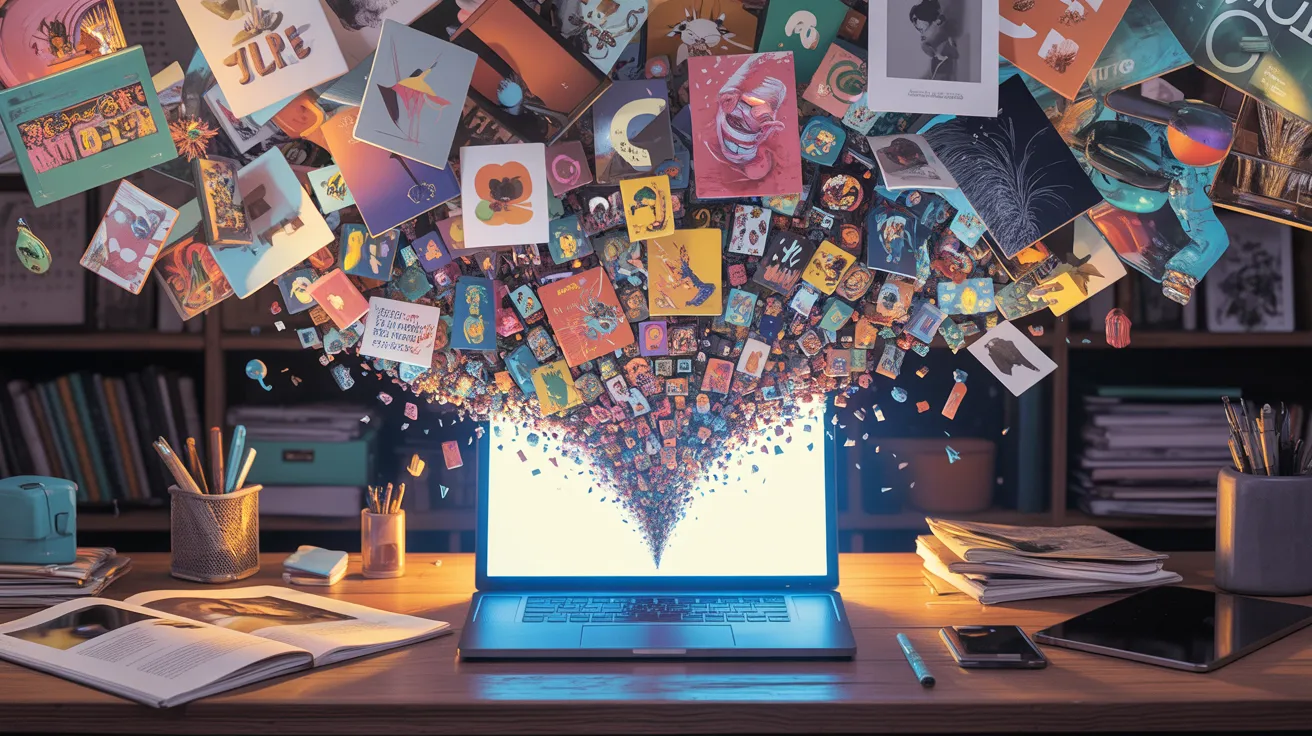
A magazine cover appears, radiant in color, produced not by the patient hand of an illustrator but in seconds by a machine. Elsewhere, artists flood their online portfolios with a blunt red icon: “NO AI.” These two images — one celebratory, one defiant — define the new fault line in art. In an era when a sentence can conjure an image, the question is no longer whether such pictures are possible. It is whether, in their sudden abundance, they gain meaning or lose it.
The Mechanism of Images
Every picture made with these systems begins in absence: static, the snow of a detuned screen. Diffusion models learn how to move from that noise back toward form. Billions of fragments — color, line, style — are drawn into their memory, so they can reconstruct what seems coherent. A phrase is typed, and from the fog emerges a castle, a face, a dream that feels both novel and already known.
This is not drawing in the human sense. It is recollection — an endless recombination of what has been seen before. The process has its wonder. Yet what matters is not just that the image appears, but that it conceals the invisible labor of countless artists whose work taught the machine to see.
Images in Circulation
In advertising, abundance is embraced. A campaign once sketched and refined over weeks now blooms instantly. Coca-Cola invited the public to generate branded art, turning consumption into authorship. Marketers praise the speed, the variations, the possibility of a thousand images at once. But when imagery is infinite, what remains of originality?
Publishing, too, has tested this boundary. Cosmopolitan’s AI cover was both novelty and declaration: spectacle at the push of a button. Independent authors followed, producing book covers and illustrations without a commission. For the writer, this is access. For the illustrator, it is absence — a missing place in the chain of creation.
Entertainment sharpens the tension. Netflix Japan’s The Dog & The Boy filled its backgrounds with AI. Executives described efficiency; animators saw lost apprenticeships, the hollowing out of a craft once passed from hand to hand.
And yet, new voices enter. A hobbyist writer, Rootport, produced a full-length manga in six weeks with Midjourney. The story appeared where, without AI, it might never have existed. For some, this is proof of democracy: imagination without gatekeepers. For others, it is evidence that when everyone can “draw,” the practice of drawing itself is made disposable.
What the Image Hides
The protests tell us what is feared. Artists covering their galleries with the red banner were not only resisting theft; they were resisting erasure. Their work had become invisible inside the dataset, yet its echoes reappeared in every generated picture.
Greg Rutkowski, a fantasy illustrator, saw his name transformed into a prompt. His style, cultivated over years, became something anyone could reproduce in seconds. The AI image presents itself as new, but behind it is a hidden borrowing — a shadow of the original hand.
This is the deeper anxiety. Copyright courts may rule on infringement, but the real question is one of visibility. Whose labor does the image show? Whose does it hide?
When Abundance Turns to Noise
Art once carried the weight of scarcity: the time of the painter, the skill of the illustrator, the vision of the photographer. With AI, creation becomes selection. The value shifts from making to choosing among the endless.
Abundance expands the canvas — enabling the non-artist to illustrate, the marketer to test a hundred variants, the designer to brainstorm without limit. But abundance also risks flattening difference. When every style can be summoned, style itself becomes generic. What once was singular now risks becoming wallpaper.
Adobe offers a curated path, promising its Firefly images are trained only on licensed or public works, each marked with credentials. This is an attempt to restore visibility and trust. Yet even here the question lingers: will curated images matter in a world already awash in the unmarked and the untraceable?
Looking Ahead
The technology grows faster. SDXL Turbo can summon an image in the blink of an eye. Multimodal tools promise pictures, voices, and video stitched together from a single line of text. The studio is no longer a place where an artist sits apart from the machine; the machine is inside the studio, shaping what is seen before the hand can intervene.
What will this moment look like, in retrospect? A liberation of imagination, or a displacement of craft? A renaissance of access, or a decline into noise? The machine cannot answer. It only produces. The decision rests with us — in how we choose to see, to value, and to distinguish the human from the infinite.
Reflection
We are surrounded by images. They arrive faster than we can look at them, let alone understand them. The double edge of AI art lies here: it democratizes vision, yet threatens to strip vision of its depth.
If we accept the flood without question, each picture cancels out the next, and meaning slips away. If instead we insist on seeing — not only what the image shows, but what it hides — then art may still hold. The future of creativity will not be decided by the machine, but by our willingness to look closely, to choose what we value amid abundance.
The flood of images is only the beginning. Already, the same engines of noise and form are reaching into film, animation, and video. When machines learn not only to draw but to direct, the tension between abundance and meaning moves from the gallery wall to the cinema screen.
The danger is not that machines can make images. It is that we might stop asking what they mean.
Next in the series: Synthetic Cinema — When AI Makes Movies
- Vincent, James. “An AI-Generated Artwork Won First Place at a State Fair Fine Arts Competition, and Artists Are Pissed.” The Verge, 2022. https://www.theverge.com/2022/8/31/23330224/ai-art-competition-win-colorado-state-fair-discord-controversy
- Roose, Kevin. “A.I.-Generated Art Is Already Transforming Creative Work.” The New York Times, 2023. https://www.nytimes.com/2023/01/18/technology/ai-generated-art.html
- Popper, Ben. “How the ‘Diffusion Model’ Became the Backbone of AI Art.” The Verge, 2023. https://www.theverge.com/23632461/diffusion-models-ai-art-explained
- Paul, Kari. “Cosmopolitan Unveils the World’s First AI-Generated Magazine Cover.” The Guardian, 2022. https://www.theguardian.com/technology/2022/jun/22/cosmopolitan-ai-generated-magazine-cover
- Peters, Jay. “Artists Protest AI Image Generators with ‘No AI’ Banners on ArtStation.” The Verge, 2022. https://www.theverge.com/2022/12/14/23509445/artstation-ai-art-protest-no-ai
- Harding, Daryl. “Netflix Anime Short The Dog & The Boy Uses AI-Generated Backgrounds.” Crunchyroll News, 2023. https://www.crunchyroll.com/anime-news/2023/01/31/netflix-anime-short-the-dog-the-boy-uses-ai-generated-backgrounds
- Rouner, Jeff. “Japanese Writer Creates Entire Manga Using Midjourney.” Houston Press, 2023. https://www.houstonpress.com/arts/japanese-writer-creates-entire-manga-using-midjourney-15347869
- Vincent, James. “Getty Images Is Suing the Creators of Stable Diffusion for Copyright Infringement.” The Verge, 2023. https://www.theverge.com/2023/1/17/23558510/getty-images-sues-stability-ai-copyright-infringement-stable-diffusion
- Stokel-Walker, Chris. “How Adobe’s Firefly AI Aims to Create Art Without Stealing It.” MIT Technology Review, 2023. https://www.technologyreview.com/2023/04/03/1070378/adobe-firefly-ai-art-ethics/
- Goodwin, Jazmin. “Coca-Cola Launches AI Art Campaign Using ChatGPT and DALL-E.” CNN Business, 2023. https://edition.cnn.com/2023/03/21/tech/coca-cola-ai-art-campaign/index.html
- U.S. Copyright Office. “Copyright Registration Guidance: Works Containing Material Generated by Artificial Intelligence.” Federal Register, 2023. https://www.federalregister.gov/documents/2023/03/16/2023-05321/copyright-registration-guidance-works-containing-material-generated-by-artificial-intelligence
- Vincent, James. “Adobe’s Firefly Shows How to Train AI Without Stealing.” The Verge, 2023. https://www.theverge.com/2023/3/21/23650680/adobe-firefly-ai-image-generator-copyright-training